
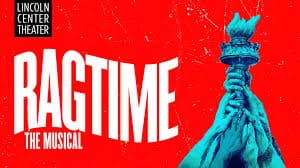
There are some shows that entertain you. Some shows that make you laugh. And some shows that change how you see the world. Ragtime, currently electrifying Lincoln Center’s Vivian Beaumont Theatre 8 times a week, does all three in a way that feels as timeless as it does urgent. With the new Lincoln Center Theatre artistic director Lear deBessonet at the helm, the show is directed with sweeping emotional precision and performed by a powerfully stellar cast. This revival is a triumph in storytelling, sound, and heart.
Set at the turn of the 20th century America, Ragtime weaves together three intersecting stories. Those of a wealthy white family and its matriarch, a black musician named Coalhouse Walker Jr., and a Jewish-Latvian immigrant, Tateh. As their lives intertwine, the characters are forced to confront their inequalities that are embedded in the american dream. We explore the trials and tribulations of their choices, hopes, and losses. Coalhouse’s fight for justice, Mother’s moral awakening, and Tateh’s struggle to create a future for his daughter. These storylines paint a portrait of a country colliding with its own dreams. The result is both epic and heartbreakingly intimate. From the first notes of the titular song, the ensemble harmonies fill the theatre with an unstoppable momentum, like history itself is bursting forward.
Ragtime explores what happens when Americas promise of equality meets the realities of prejudice, progress, and power. Coalhouse’s journey for justice, Mother’s awakening to empathy, and Tateh’s pursuit of opportunity all collide, revealing how innovation and injustice shaped the same century. It’s not just history, it’s the origin story of the modern American conscience.
What makes Ragtime extraordinary isn’t just its scope, but its soul. Lear deBessonet approaches the material not just as a museum piece but as a living document. One that demands to be felt, not just admired. Every scene feels freshly urgent, every line feels lively, and every moment of silence feels perfectly deliberate. deBessonet has assembled a dream team to bring her vision to life including Linda Cho’s costumes which bring this world vividly to life. The white New Rochelle family glows in white and bright pastels that almost seem to pristine. By contrast Coalhouse’s Harlem community radiates warmth with deep reds, oranges, and golds that feel textured and human. As the story unfolds and these worlds begin to intertwine, Cho subtly lets the colors bleed together, visually mirroring the shifting boundaries of class, race, and hope. Her costumes pair beautifully with Adam Honoré’s lighting design which adds its own emotional language to the production. His lights transform the stage into a living painting through piercing blues, crimson glows, and soft violets. During Wheels of a Dream, the stage warms into a soft sunrise that feels almost sacred. Later, as tragedy looms, a cold white spotlight isolates Coalhouse in a stark contrast to the surrounding darkness.
At the center of it all is Joshua Henry’s Coalhouse Walker Jr., whose voice fills the Beaumont with thunder and grace. He commands the stage not just through power, but with vocal and emotional control. He portrays Coalhouse as a man whose dignity becomes his revolution. His Make Them Hear You doesn’t feel like a performance, it feels more like a prayer sent up to the rafters, and the audience listens with baited breath and reverent silence. The production’s power expands with Caissie Levy’s interpretation of Mother is luminous, she captures the quiet transformation of a woman awakening to empathy and injustice. Her Back to Before is heartbreaking in its simplicity, Sung not as nostalgia but as a solution. Then Nichelle Lewis as Sarah sings with raw, aching, powerful purity. Her Your Daddy’s Son is one of the most devastating moments of the night. Meanwhile, Brandon Uranowitz breathes new life into Tateh through humour, hope, and heartbreak in an equal balance, and Shaina Taub’s Emma Goldman is a firecracker that crackles with fierce conviction.
At the end of the night the audience is watching history before their eyes. Ragtime reminds us that progress has always been messy, and that America’s promise is a melody still unfinished. To quote Shaina Taub’s musical Suffs “progress is possible, not guaranteed.” This production is beautiful yet tragic. It’s a call to listen. For students, artists, and anyone who belives theatre can change the world. What gives this its force is the way it reflects our present without forcing the comparison. Go see this production and let it reignite your belief in what art can do and how it can reflect what is happening in the present and dare us to imagine better.
Ragtime is playing at the Vivian Beaumont Theatre at 150 W 65th St until June 14th, 2026.