
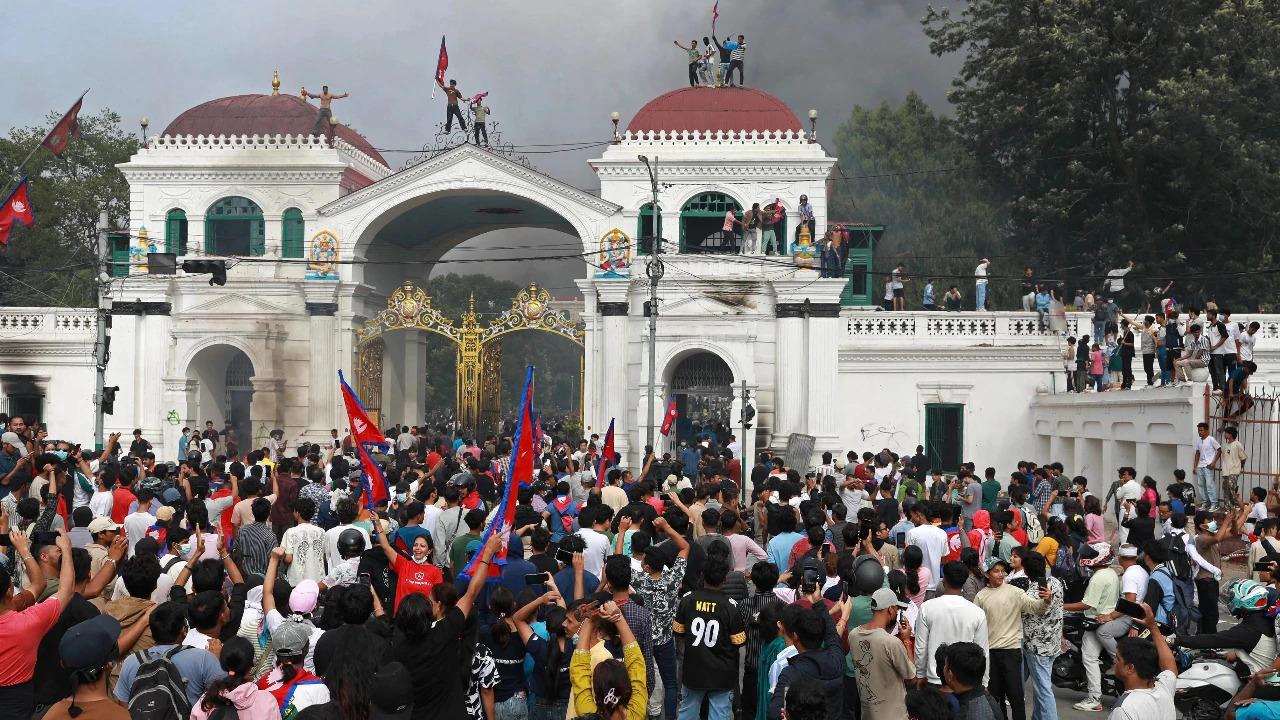
Prithvi Subba Gurung, Nepal’s Minister of Communication and Information, shares that these social media companies had been told to officially register their companies, and after multiple notices, had been blocked. Only around 5 social media platforms had registered in Nepal, and were allowed to remain, including Tiktok and Viper, which Nepalese citizens used to display their displeasure in this ban.
The social media ban was set in place after a trend online went viral, a trend of criticizing the corruption and nepotism that ran rampant among politician’s families. These complaints were often accompanied by images of government officials displaying large amounts of wealth, images that greatly upset the public. For reference, the average Nepalese made ~1400 usd a year. Critics believed that the social media shutdown was promoted by this trend, and was a form of censorship, which increased tensions during protests. The Nepalese were sick of watching the wealthy live in luxury while they worked to the bone.
Additionally, Nepalese citizens no longer had access to Linkedin, which is essential to the average Nepalese citizen due to a lack of in-country employment. Nepal’s economy also heavily relies on people sending money back home, taking up 33% of Nepal's Gross Domestic Product (GDP). To put it into perspective, from 2024 to 2025, the Department of Foreign Employment issued 839,266 exit labour permits, an abnormally high amount for a country of ~30 million people. This means out of those employed, more than half of the population works outside of the country. Due to the volatile job market in Nepal, online work is one of the main ways Nepalese citizens receive income, and so banning social media prevents a large majority of the nation from searching for work.
Starting September 8th, tens of thousands of GenZers, many of them students, gathered in Nepal’s capital city, Kathmandu, clustered near Maitighar Mandala, a symbolic monument, and the Federal Parliament building. These young adults were not focused on their right to doom-scroll, but the essential uses of these social medias. These were not screen addicted young adults, but citizens with their livelihoods stripped. As a result of this social media ban, on top of an already corrupt government, a nationwide protest began.
September 8th
The September 8th protests in Kathmandu were organized by Hami Nepal, a non-profit that supports individuals and communities during the crisis. was set up after tragic earthquakes in 2015, and has organized protests guided by its motto, “For the people, by the people”. One of the protest organizers, Anil Baniya, argued that at the September 8th protests, the government forces responded harshly to one of the protesters throwing a rock at a CCTV camera by shooting live ammunition. Baniya stated that what had begun as a peaceful protest had been hijacked by "external forces and political party cadres" but that regardless what the armed police were out of line.
Most of the violence took place when protesters attempted to enter the Federal Parliament building. Tear gas, rubber bullets, water cannons, and live ammunition was used by government forces on the protesters, leading to at least 19 people being killed and over 347 injured. The news network France 24 explains that, “Videos of police violence started appearing online on Monday afternoon, first on TikTok, which is still authorised in Nepal, and later on other social media outlets. The images show people with serious injuries and covered with blood. Some are inanimate and lying on the ground. Many of the victims clearly have injuries to their heads or their torsos. Other images. . . feature people whose faces have been completely blown off.” Deputy Director of Human Rights Watch's Asia Division, Meenakshi Ganguly, confirms “It was completely in violation of all legal standards on how police are supposed to control violence because, first of all, they are not supposed to use live ammunition unless it is absolutely necessary. And even if they are using live ammunition, obviously, they should always aim to cause minimum harm. Shooting people in the head is not causing them minimum harm. Usually, the police tend to aim for the legs during a protest. A lot of witnesses told us that they were shooting at chest level, which caused the fatalities. It’s absolutely unprecedented.”
That evening, the Kathmandu District Administration Office imposed a curfew on certain areas of the city near government buildings, however protests continued. Following this, the social media ban was lifted and Ramesh Lekhak, the home minister, resigned. A curfew was imposed upon several major cities throughout the country, including Kathmandu, Birgunj, Bhairahawa, Butwal, Pokhara, Itahari, and Damak. After seeing the initial response of the government towards the protesters, their goal changed. They now demanded “for the complete dissolution of parliament”.
September 9th
The morning of September 9th, 2025, varying government responses to these protests caused more chaos. Prime Minister K. P. Sharma Oil issued a directive to ministers of his political party (the Communist Party of Nepal) to not resign from their posts, before he himself resigned and fled to army barracks in Budkanilkantha. Reports were sent out, saying President Ram Chandra Poudel resigned, though the Nepal Army denied this. Protests continued nationwide, resulting in over 25 government buildings and homes of government officials being set on fire. The list below names all the targeted buildings.
Part of Singha Durbar, the administrative headquarters of Nepal
The Supreme Court of Nepal
The Official Residence of the president
The prime minister’s residence in Baluwatar
The headquarters of the Communist Party UML
The Parliament building
The headquarters of UML and Nepali Congress were vandalized, party flags were stripped and burned
Kantipur Media House
House of Former prime minister, Sher Bahadur Deuba
House and vehicle of Deputy Prime Minister, Prakash Man Singh
House of Former President, Bidya Devi Bhandari
Residence of Former Prime Minister, Jhala Nath Khanal
Residence of Former Home Minister, Ramesh Lekhak
Houses of Rupandeshi’s local politicians Bal Krishna Khand, Bhoj Prasad Shrestha and several majors
House of Former Prime Minister Prachanda
House of Former Prime Minister Prachanda’s daughter
Several government offices in Hetauda
Parliament building (Karnali Province)
Residence of Chief Minister Yam Lal Kandel
The District Office and District Court of Biratnagar
Residence of Chief Minister and Cabinet Ministers of Biratnagar
Building of the Road Department
Office of Commission for the Investigation of Abuse of Authority
Chandragiri Cable Car
CG Electronics Digital Park
Balambu
Thankot Police Station
Hilton Hotel
The Ministry of Health building
Other concerns of safety grew as the protests progressed. Several prisons were also attacked by protestors, such as the prison in Kailali district, where all the inmates fled. Politician Rabi Lamichane, Former Deputy Prime Minister of Nepal was set free from Nakhu Jail, which was later set on fire; all prisoners fled. Kaski prison was also set on fire, resulting in 773 inmates escaping. Security forces, including the Nepal Army, provided safe evacuation of political leaders from affected areas to Tribhuvan International Airport (TIA). Minister of Agriculture Ram Nath Adhikari and Health Minister Pradip Paudel along with 21 MPs from the Rastriya Swatantra Party resigned, along with all the MPs of the Rastriya Prajatantra Party. Several members left Oli's UML party. Protestors went to TIA to stop the politicians from fleeing. Subsequently, the airport was closed and taken over by the army, as they tried to control the arson and destruction. Hundreds of travelers were stranded at TIA and flights were either redirected to a different airport or were canceled. In the end, at least 33 protesters were injured and 3 policemen died.
Once again, curfew was imposed on major cities. Armed forces and police went house by house, searching for protesters, going as far as searching a hospital where protesters were taken after being gravely injured in protest. A friendly football match between Nepal and Bangladesh was canceled. That evening, at 10pm, the army declared they would take charge of the country in lieu of the Prime Minister, claiming they would maintain law and order.
September 10th
In the early morning of September 10th, 2025, army forces were seen patrolling neighborhoods heavily affected by the protests. Later, General Sigdel, Chief of Army Staff of the Nepalese Army, urged protesters to stay peaceful. However, some protesters continued to raid government buildings and homes of politicians, seizing countless firearms, though the pace of these actions slowed down by noon. Many army weapons were also taken. Between 10am of September 9th, and 10pm of September 10th, 27 people were detained for looting, arson, other “destructive and anarchic activities”, and seizing weaponry; reports counted 31 firearms. Police stated that out of the more than 13,500 prisoners that escaped the day before, 303 of them had been apprehended. 73 rifles were returned.
On the other hand, it is important to note that a group of protesters did begin to clean the street near parliament, which was set on fire the day before.
Meanwhile, online discussions occurred on Discord, as more than 100,000 citizens debated over who should become the temporary Prime Minister of Nepal. There were three main candidates: Balen Shah, Kul Man Ghising and Sushila Karki. Sushila Karki was selected as the protester’s choice of Prime Minister, as she had previously served as the chief justice of the Supreme Court of Nepal from 11 July 2016 to 6 June 2017, and showed a strong intolerance for corruption. Later, she confirmed her willingness to take the position in an interview with News18, and the protesters would push her name during negotiations.
September 11th
The next day, a meeting was held at Bhadrakali army headquarters that included President Poudel, General Sigdel and Gen Z representatives, to discuss the interim leader. The Gen Z group promoted Sushila Karki, while other names were suggested, such as Balendra Shah, Kul Man Ghising, and mayor of Dharan, Harka Raj Rai. Soon after, CPN (Maoist Centre) Chairman and former Prime Minister Pushpa Kamal Dahal 'Prachanda' released a press statement on his party’s opinion on the protests. According to The Himalayan, “In his 10-point statement, Prachanda paid tribute to the young protesters who lost their lives and expressed condolences to bereaved families. He said the government's "barbaric crackdown and massacre" against youth demanding good governance and accountability was to blame for the current turmoil. Prachanda also distanced Gen Z protesters from widespread acts of arson and vandalism that followed, including attacks on Singha Durbar, the Supreme Court, and political offices, arguing such incidents were the work of "unwanted elements" who infiltrated the movement.”, as well as urging the protesters to work within the democratic framework. Meanwhile, the death toll increased to 34, while more than 1,300 people were injured, according to Nepal's Ministry of Health and Population
September 12th, 13th and the Aftermath
On September 12th, 2025, the death toll reached 51 people, including 21 protesters, 9 prisoners, 3 police officers and 18 others, with more than 1,300 people injured nationwide. Sushila Karki was inaugurated as the first female Prime Minister of Nepal, followed by President Poudel dissolving the parliament and setting March 5th, 2026 as the date for the next election. The following day, curfew in the capital city was lifted. Prime Minister Karki began visiting protesters in the hospital, and by the afternoon, calm was said to be restored. Later, Prime Minister Karki declared that anyone who lost a family member to the protests would be compensated with 1 million Nepalese rupees, (~$7000 usd in 2025). Those injured will also be compensated. In the end, at least 72 people were killed in protests, with more than 2,100 injured, and the social media ban stayed lifted. We will see on March 5th whether the government will truly be changed as 275 members for the house of representatives will be elected, as well as the next Prime Minister of Nepal.